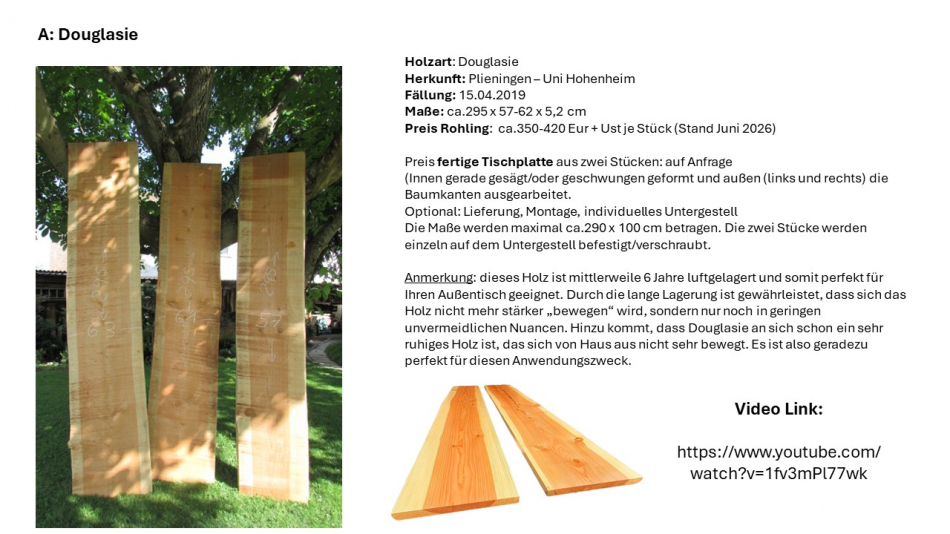
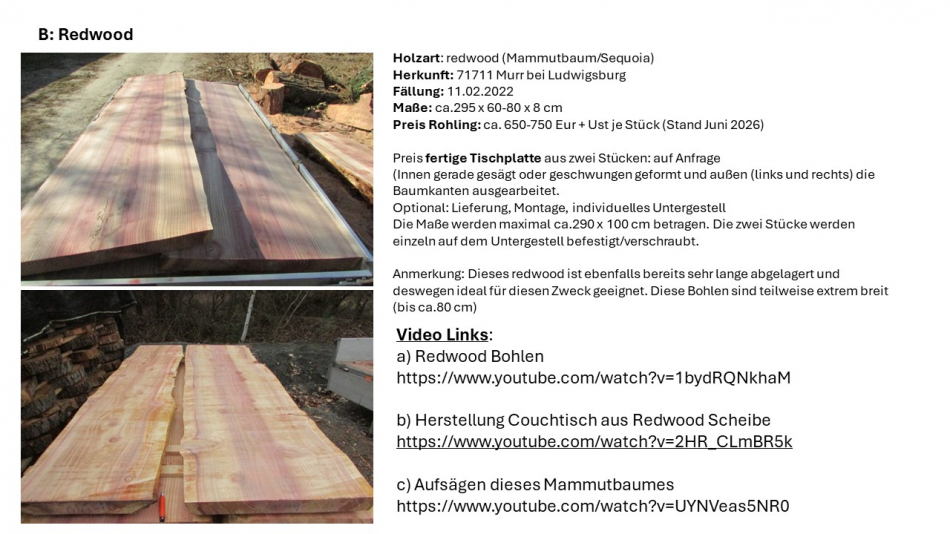
just contact me
Topic: What is the best type of wood to use for a garden table?
First things first:
Using wood without protection is never a good idea; wood does not mix well with water or snow. If the table is protected from the elements (e.g., by a roof), it will last much longer and stay looking good. Temperature fluctuations between summer and winter, as well as dryness and humidity, are also bad for wood. This means it is subjected to extreme stress, which can lead to cracks and warping. Over time, it will definitely change color (graying), and this will happen regardless of whether it is treated with oil, etc., or not. This applies to all types of wood. However, there are woods that “tolerate” this better or are more resilient and can withstand it better. Among native wood species, these include not only oak and black locust but also larch and pine. Among naturalized wood species, these are primarily Douglas fir and redwood. However, every wood species has its own characteristics, which one simply must be aware of.
Oak contains a high amount of tannic acid (as does black locust), which can be washed out by rain and may cause very stubborn stains underneath the table (if the table is protected from rain and snow, this is not an issue). The sapwood in oak—and especially in black locust—is typically heavily infested with insects when the wood is used outdoors. Pine has the issue of resin pockets, which can liquefy and burst open in extreme heat (direct sunlight in summer) - though this happens only once (once they’ve leaked, they’ve leaked)—and can be removed (with a plane, chisel, or sanding). Douglas fir also has this issue, though to a lesser extent. Thus, both Douglas fir and redwood are the most ideal woods for this purpose; however, these two woods (pine as well, though to a lesser degree) still have the tendency to flake off thin layers of wood, i.e., thin layers or splinters (usually in the tangential area) can detach and bend upward or come loose entirely; that is, this can happen over time due to the extreme temperature and humidity differences described above. Repairing this is rather difficult (you can plane it down, remove it completely, and possibly fill it with epoxy resin), but it is not impossible - or you can simply live with these natural variations.
Regarding surface treatment:
If the table is left unprotected and exposed to the elements, I recommend not applying any surface treatment, as the types of wood mentioned are very durable and will weather over time, thereby forming a natural protective layer.After the wood has weathered (in about 3–4 years), you can use a garden maintenance oil (recommendation: Auro Garden Furniture Oil No. 102-92, available in transparent or tinted versions) and impregnate it with a garden furniture oil beforehand for additional protection. Old shingle roofs and house facades were also mostly not treated in the past (sometimes they have been painted with linseedoil).
However, won’t the wood then be unprotected against liquids/food (wine, coffee, blueberry pie, etc.)?!
If the table is going to be used extensively for eating and drinking, I would recommend the following:
In my opinion, the best option is to treat the entire table (top, bottom, and sides) with garden furniture oil (you can find a suitable oil, for example, at “www.auroshop.de”). In this case, the sequoia will absorb many times more oil (possibly even a factor of 10)—the sequoia “soaks it up like a sponge”—meaning that, in the case of the sequoia, this would add several hundred euros in costs just for the oil. Or you could try something from a home improvement store, e.g., from Osmo, if the organic component of the oil isn’t that important (Osmo products simply contain more chemicals, but are otherwise good products). With Douglas fir, this is within the normal range; a 375-ml can will likely be sufficient for a standard-sized table.
Below are some specific examples from the Patrick Herrmann table workshop in Stuttgart
